Lisbon. PESSOA GUIDES US THROUGH THE ALLEYS OF THE CITY OF LUSITANIAN
9th April 2020
The author of the Book of Restlessness takes us to admire the artistic and architectural masterpieces of Lisbon.
by Fabio Massimo Penna
A city is bound, often in an indissoluble way, to the name of a great personality, artist or literate who becomes the emblem. We have already seen how Prague-Kafka is an unavoidable combination and even the name of Fernando Pessoa is combined with that of Lisbon, a city that dedicated to the writer a statue in front of his favorite place, the café A brasileira. The bond between the writer and the Portuguese metropolis is so intense that Pessoa dedicates an authentic tour guide to her: Lisbon-What the tourist must see. Born in the city of Lusitanian in 1888 the writer lives, due to the marriage of his widowed mother to the Consul of Portugal, in Durban in Africa from 1895 to 1905. After returning to Portugal his life takes place mainly in Lisbon in the District of Baixa. Considered the greatest Portuguese writer, Pessoa has hidden his figure behind a series of heteronos (invented names to which his works are attributed): Bernardo Soares, Alberto Caeiro, Ricardo Reis, Alvaro de Campos. To complete fiction, hetheronisms are attributed a biography, a work, a character. Such is his identification in these characters that the only serious relationship of his existence, that with Ophelia Queiroz, is marred by the intrusive presence of Alvaro de Campos, who writes letters to the woman turning into a kind of imaginary third inconvenient. The talent of the Lusitanian writer is revealed in all its greatness at his death as the world discovers that much of the masterpieces of modern Portuguese literature were written by a single man hidden under fictitious names. Autobiographical cues dot what is one of the greatest masterpieces of the twentieth century, the book of restlessness (Livro do desassossego) a kind of diary kept by Bernardo Soares, alter ego in which the writer reverberates his personality. Also in the field of poetry Pessoa shows lyrical skills not indifferent as evidenced by the verses with which he defines the work of the poet in Autopsy: "The poet is a pretender/pretends so completely/to pretend that it is pain/pain that he really feels."
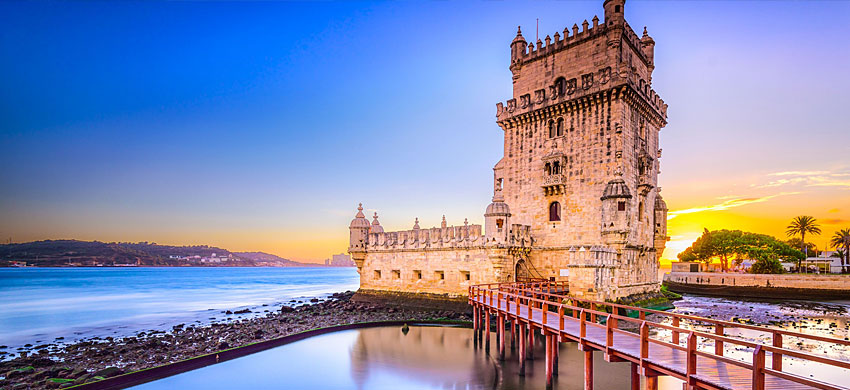
Let us, therefore, let It be Pessoa and his Lisbon-What the tourist must see to guide us in the city of Lusitanian, to accompany us through the alleys of Baixa, Bairro Alto and Alfama. From the city tour we take the most interesting sites starting from the enchanting Tower of Belem, an example of the "manuelino" style (named after King Manuel I) that characterizes Portuguese architecture in the early 16th century. The Manuelina architecture exhibits a decorative exuberance that extends the ornamental motifs even to the columns and sometimes in a mixture of Gothic and Renaissance components with Moorish presences. Also in the Belem district, in the port area, is the Jeronimos Monastery, a wonderful stone structure. Made in the Manuelino style, the Jeronimos monastery with Gothic-flowering and Renaissance styles combines Islamic and Indian traces. The facade is the sumptuous portal with niches, statues, reliefs, emblems harmoniously tied together by a wise hand. The interior of the three-nave church is adorned with a magnificent pulpit and a terracotta of Luca Della Robbia representing St. Jerome of which Pessoa says: "This image refers to the story of Philip II of Spain who, facing the church exclaimed 'No me hablas Hieronimo? (don't you talk to me, Geronimo?)" (Fernando Pessoa, Lisbon-What the tourist must see,Passigli publishers, Florence-Antella, 2003). The tabernacle of the main chapel with silver cover, the work of Gil Vicente and in the Almeida Garrett Chapel, the tombs of Luis de Camoes and Vasco de Gama should also be remembered.
Near the garden of the Estrela (where you can admire specimens of exotic flora) is the Basilica de Estrela, a votive church built in 1799 and wanted by Queen Mary I on the occasion of the birth of her son. The building, with a longitudinal development with a Latin cross plan, has a late-baroque facade with niches, statues and a double bell tower. The interior is decorated with statues of Machado by Castro and paintings by Pompeo Batoni, a Lucca artist famous for his effigy portraits in front of classical ruins, with which travelers intended to bring to their country a testimony of their grand tour on Italian soil. The Church of San Roque offers us a singular surprise. Inside is the chapel of St. John the Baptist, performed in Rome by Nicola Salvi on the project of Luigi Vanvitelli, in St. Anthony of the Portuguese, where he receives the blessing of Pope Benedict XIV, and dismantled is taken to Lisbon and placed inside the church of San Roque. An authentic grafting of a piece of Rome inside Lisbon. It is getting late by now, we greet our guide Pessoa or Reis, or Alvaro de Campos, or Caeiro, whoever he is. He won't be able to follow us on our last visit. Let's go, in fact, to see the Cultural Center of Belem, designed by Vittorio Gregotti between 1988 and 1993. It is a structure that develops horizontally and overlooks the River Tejo, in an area between the monastery of the jeronimos and the tower of Belem. The use of split stone is a tribute to the nearby convent of the jeronimos, as is typically Portuguese the calcada (two-tone stone floor) of the museum area. The center is a huge structure with exhibition spaces, auditoriums, theatre, meeting rooms and offices.