Barcelona. GAUDI'S FLAIR SHAPES THE SKYLINE OF THE CATALAN CITY
17th April 2020
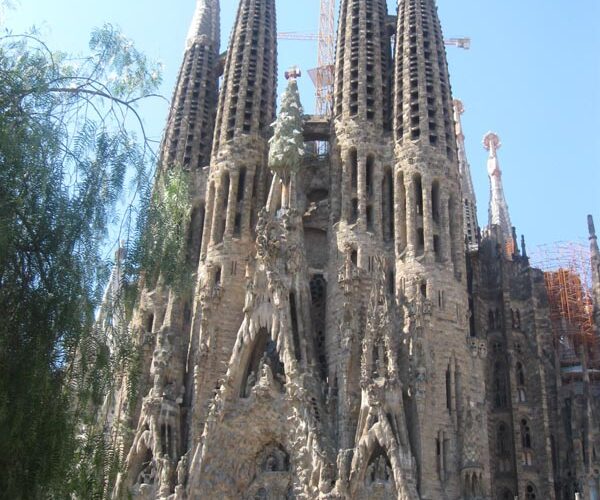
Barcelona's modernism goes perfectly with the eclecticism of the great architect of Reus.
by Fabio Massimo Penna
Barcelona and modernism. The face of Barcelona is dominated by the modernist architectural style. The Catalan city in the nineteenth century is booming economically and in need of an architectural renewal, becoming fertile ground for modernist aesthetic research, dominant at the time in Spain, whose cornerstones were the flexible curved line and the preponderance of the floral ornament. The movement sank its inspiration into the forms of nature with a wavy line and an extraordinary decorative richness. A great innovative wave impetuously travels through Europe, in the period from 1890 to the First World War, in the figurative and applied arts and architecture. In Spain the movement is called "Modernism" in Italy is called "Liberty" style (or floral), in Germany" Jugendstil, but more generally it is called "Art Noveau". At the root of this current is the desire for a widespread artistic and aesthetic quality that can permeate the cities and the lives of citizens. In this way even the everyday, the banal, the ordinary is elevated at the level of aesthetic experience, even in the common object you can find a poetic value. In this cultural temperie the modernist trend of Barcelona develops and thus a skyline is born dominated by great freedom, imagination and movement in which the flair of Antoni Gaudi fits harmoniously.
An endless construction site. Started in 1883 the Sagrada Familia, the work of a lifetime of Antoni Gaudì, is still under construction. The dedication to the project of the architect of Reus is such that in the last two years of his life he transfers his residence inside the construction site. All pointless: he will never see the end of the work. Also because on June 7, 1926 Gaudì was overwhelmed by a tram and died three days later in hospital. To seal his union with the Sagrada Familia the architect is buried in the crypt of religious construction. Eighteen towers were planned in the project, but only eight were actually built. The structure is a clear example of Gothic verticalism with slender towers stretching out to the sky. The tapering of the towers, the high-pitched portals, the oblong windows confirm the upward shot of the complex concluded by a series of polychrome spires. The interior resembles a stone forest with columns referring to eucalyptus trees. These sloping columns are a true engineering masterpiece with their ability to absorb horizontal thrusts.
Fairytale dwellings. Gaudì's eclectic flair and decorative creativity find maximum expression in Casa Battlò. Here the architectural innovations break the links with tradition to create a mind-blowing and utopian dwelling. The dinosaur-backed roof with its wavy line, the mosaic formed by ceramic fragments that reflect sunlight, the balconies in the shape of a carnival mask, the bulb that ends the turret: everything contributes to give the facade an enchanted appearance of fairy tale or dreamlike state. The ornamentation, a typical fact in Gaudì, seems to draw inspiration from animal and plant forms. The same architectural freedom innerva Casa Milà, called the pedrera for its stone quarry appearance. The facade, moved by wavy shapes and a game of concave and convex follows, with its roundness, the trend of the road on which it overlooks. The moving line dominates the roof on which the architect unleashes all his imagination in the extravagant forms of the imposing fireplaces that stand out like abstract sculptures.
The park of quirks. The same endless sequence of formal inventions is present in the lush Guell Park, an authentic mine of fantastic finds. The entrance with the double staircase is dominated by the polychrome mosaic sculpture of a huge salamander. The column room shows in the ceiling a series of colorful mosaic medallids and is supported by a forest of fluted Doric columns that in the lower area are surrounded by a monochrome mosaic with white tiles. On the terrace a sequence of benches, the shape of which recalls the teacups, is adorned with a mosaic in pieces of tiles and stained glass with fantastic motifs that follows the undulating trend of the balcony. In his irrepressible imagination, the architect of Reus creates indoor streets carved into the rock and supported by sloping walls. As will happen later for the Sagrada Familia, Gaudì will live for a time in the park in the old house of the Guell family.
Contemporary architecture. In the Barcelona skyline stands out, almost contrasting with the towers of the Sagrada Familia in a vertical challenge, Jean Nouvel's Torre Agbar. The structure stands like an ultra-modern aerodynamic bell tower, with its shape of a missile, a strip of color that with its blue reflections mimics a geyser that blazes rising from the city ground.