Padua. FROM GIOTTO TO DONATELLO JOURNEY IN THE ARTISTIC JEWELS OF THE VENETIAN CITY
June 3, 2020
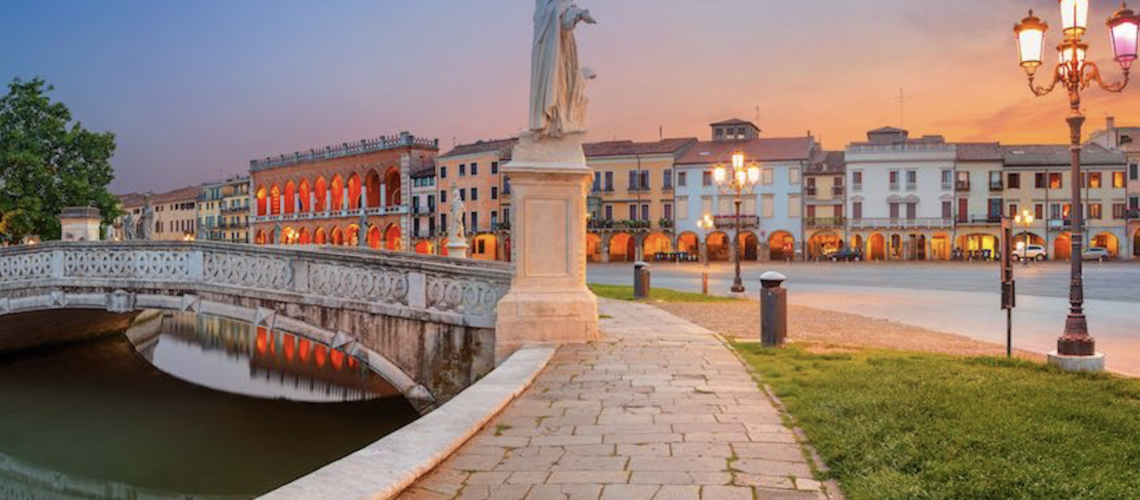
From the splendour of the Chapel of the Scrovegni to the extraordinary architecture of Caffè Pedrocchi Padua, it confirms a city to visit absolutely.
by Fabio Massimo Penna
A symphony of colors. The visitor who arrives in the Chapel of the Scrovegni is ecstatic in the face of the stories of Christ frescoed by Giotto. The Tuscan painter shows an extraordinary narrative ability combined with a realism that makes his painting a kind of fascinating theatrical recitation: "We seem to witness the real event as if it were recited on the proscenium" (E.H.Gombrich, The History of Art, Phaidon Press Limited, London). In his unreachable pictorial dowry Giotto manages to return the tactile qualities of the things depicted, with a marked line that defines a barely restrained volumetric energy and the vibrant colors that give robustness to the shapes. The artist's interest is addressed not only to gestures and bodily movements but also to inner impulses, to the motions of the soul. The great size and harmony give Giotto's painting an extraordinary naturalness. The frescoes of the Chapel of the Scrovegni are made between 1302 and 1305, after a period spent in Rome during which he has the opportunity to learn about the work of Pietro Cavallini. Previously, between 1296 and 1299, he had been in Assisi where he had created the frescoes with the Stories of St. Francis in the Upper Basilica.
Padua plays a key role in the spread of Renaissance novelties in northern Italy. In 1443 one of the three fathers of the Renaissance, Donatello (the other two are Brunelleschi and Masaccio) arrives in the Venetian city where he resides for ten years. The Padua cultural environment proved extremely receptive and the presence of the great sculptor left a fruitful trace that would allow a development in the 'modern' direction to Venetian art. Two works involve the Florentine artist: the equestrian monument in Gattamelata and the altar of St. Anthony in the church of the same name. The statue of the leader of Narni, placed on a high plinth, can be seen from a lowered position and is framed by the diagonal line that starts from the command stick and continues in the lining of the sword on the side of the rider, while the advancing movement of the horse is blocked by the ball placed under his paw. The sculpture, which stands out imperiously in the city space, was conceived as a cenotaph (a funeral monument devoid of the remains of the effigy) of Erasmo da Narni. The sculptural reference is the Chapter Marcus Aurelius. The altar of St. Anthony had a huge impact on the northern artistic environment. The arrangement of the statues is due to a recomposition carried out by Camillo Boiro in the late nineteenth century. The sculpture of the Virgin with the Child and the six saints formed an extraordinary sacred conversation with plastic relief and three-dimensionality. Currently, a dramatic bronze crucifix looms over the group. In the reliefs below, the Deposition of Christ inthe tomb, made in porfido with the grafting of colored marbles, exhibits a space hidden by the crowding of figures dramatically drawn to the foreground. The bronze bas-relief with the Miracle of the Heart of the Sting is characterized by the wave motion of the mass of featured characters inserted in a perfectly drawn-in-perspective architecture. The Miracle of the Mule also shows the sculptor's perspective in the three large barrel-turned arches under which the prodigious event takes place.
In the hermites complex, the Ovetari chapel was frescoed by Andrea Mantegna. We point out to you as the cycle was destroyed by a bombing during World War II. The frescoes with the Martyr of St. Christopher and the Martyr of St. James already showed the cutting line that gives statuesque consistency to the Mantegneque figures, the perfect perspective rendering and the passion for archaeology of the extraordinary works that followed.
A place where gentlemen could sip coffee and maybe smoke a cigar and discuss the news read in the newspapers. These noble thoughts were to occupy the mind of the Venetian architect and engineer Giuseppe Jappelli while designing the Coffee Pedrocchi (1816 – 1820) in Padua. We are facing an absolute masterpiece of neoclassicism in architecture. Trained through trips abroad, especially in France and England where he distinguished himself in the design of gardens, Jappelli connoted the construction with an austere Doric style in order to organize the spaces with rationality and consistency. The two Doric avant-bodies frame the central back part that refers to the Corinthian order. In 1836 Jappelli joined the coffee industry in the pastry industry called Pedrocchino. He brilliantly designs it in the neo-Gothic style, thus creating a pleasant contrast with the structure of Pedrocchi. The two buildings become a kind of outdoor city lounge, a pleasant meeting place for the population. This dual architectural masterpiece refers to the importance that at the time was conferred on the idea of Caffè as a place of exchange of ideas: "The Pedrocchi of Padua, the city home to an ancient and renowned university, was above all the center of intellectual and political life" (Piero Adorno – Adriana Mastrangelo, Art and Artists, G. D'Anna Casa publishing, Florence, 2002).