PARMA. FROM CORREGGIO BACKGROUNDS TO THE RENZO PIANO AUDITORIUM
January 18, 2021
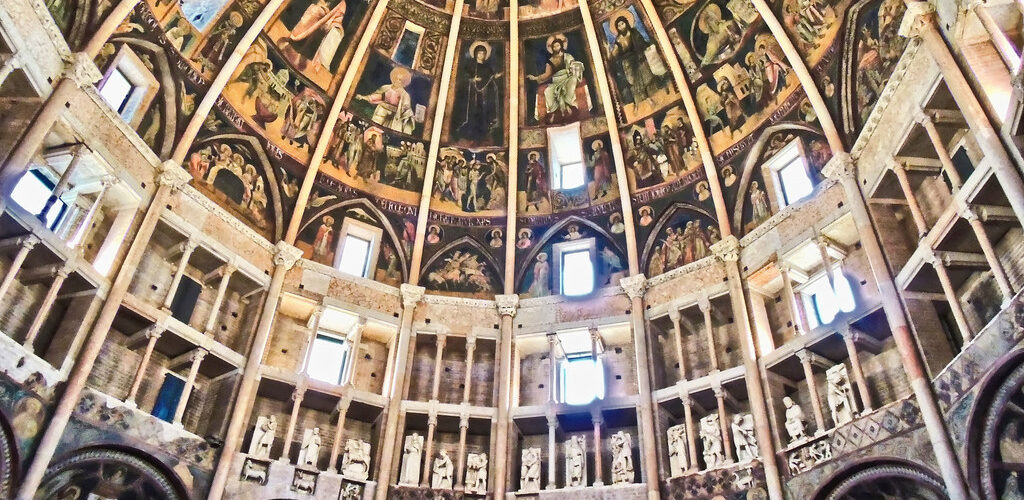
Parma offers the visitor the opportunity to admire splendid theatrical buildings, from the Farnese Theater to the Niccolò Paganini Auditorium, and artistic masterpieces such as the domes of the Church of San Giovanni Evangelista and the Duomo.
by Fabio Massimo Penna
From Giovan Battista Aleotti to Renzo Piano . The theater in Parma enjoys a great architectural tradition starting from a wooden structure like that of the Farnese Theater , built in 1618, and destined to become a prototype of a theatrical building with its elongated U shape, ending with the transparency of the ' Niccolò Paganini Auditorium built between 1999 and 2001 by Renzo Piano. For its construction, Aleotti opts for a classic system "It is a large space (the archstage has 12 meters of opening, the stage is 40 meters deep and the room measures 87 by 32 meters), with an equipped stage of machineries from above and guides and winches to change the wings on sight, framed by a monumental archstage with two triumphal arches on either side ”(Fabrizio Cruciani, The space of the theater , Laterza editors, Rome-Bari, 1992). The structure develops in length and is equipped with a deep and wide scene. Built on the first floor of the Palazzo della Pilotta, the Farnese theater is a fundamental model for the Baroque scene with the spectators arranged on the semi-sphere steps on which two orders of serlian arches stand out, surmounted by a gallery embellished with statues. The theater was built for the passage of the Grand Duke of Tuscany Cosimo II to Parma, but a mishap prevented the long-awaited visit. The inauguration of the work was postponed for about ten years and took place in 1628 to celebrate the wedding of Odoardo, son of Ranuccio I Farnese, and Margherita de 'Medici, daughter of Cosimo. The Niccolò Paganini Auditorium is an essential, absolute structure that plays on the interaction between exterior and interior. A hymn to lightness with the masonry walls that alternate with the windows of the facade and the back. Renzo Piano succeeds in the miracle of making the auditorium and the surrounding park appear as a single whole: nothing blocks the gaze that is lost on the horizon while the musical notes caress the ears. Completing the ensemble are the accessory buildings with the rehearsal room. For opera lovers, a visit to the neoclassical Teatro Regio is essential, considered a temple of the Italian opera tradition.
In the Convent of San Paolo, visitors can admire the Chamber of the Abbess , whose vault was frescoed in 1519 by Antonio Allegri known as Correggio . Here the Emilian painter manages to combine Renaissance rigor and mannerist excesses in a relatively small space. The vault of the room is divided into sixteen segments in a sort of imaginary pergola, with oculi in which putti carrying the attributes of Diana move, frescoed with her chariot above the chimney hood, while the lower area is adorned with lunettes monochrome that simulate ancient bas-reliefs. The presence of Correggio in Parma is important and testified by two masterpieces such as the "sfondati" of the Church of San Giovanni Evangelista and the Duomo. In the vault of the dome of the two sacred buildings Correggio "experiments with the sfondato, the fresco that simulates an open sky" (Pierluigi De Vecchi - Elda Cerchiari, Art in time - From the Late Gothic to the Rococò , Gruppo Editoriale Fabbri, Bompiani, Sonzogno, Etas, Milan, 1991-92). The inspiration for this pictorial technique is to be found in the Mantuan Camera degli sposi by Andrea Mantegna and in particular in the oculus of the vault. In the Church of San Giovanni Evangelista the painter frescoes The vision of San Giovanni in Patmos with the dome depicting a sky surrounded by clouds with Christ suspended in the center and St. John hidden under a circle of clouds observing the event. Correggio's virtuosity is evident in the glimpses of the figures. The Assumption of the Virgin in the Cathedral is characterized by the whirling circular motion of the angels lined up in circles on the clouds in a concentric swirl that ends in the figure of the Virgin floating in the sky. The interpenetration of painting and architecture creates an illusionistic drive towards infinity. In these domes the portentous imagination of Correggio is freely expressed, anticipating the large breaches of the Baroque era.