Athens. GREEK THEATRE FORGES THE CULTURAL IDENTITY OF THE WEST
23rd April 2020
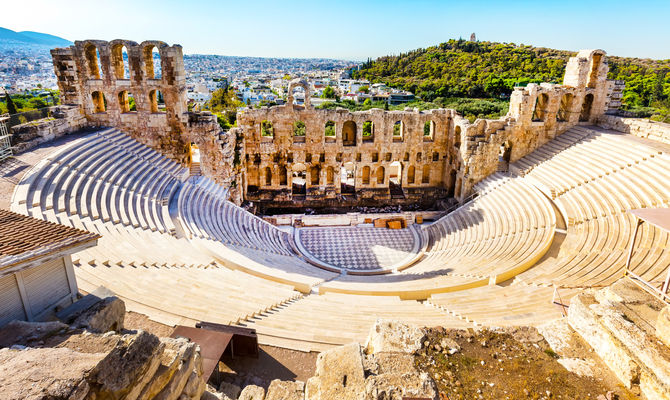
On the journey in search of the roots of our civilization can not miss a visit to the theater of Dionyso in Athens.
by Fabio Massimo Penna
The journey to the origins of Western civilization took us to Greece to Athens. Our culture was born in these lands and finds its own powerful expression in the theatre. Although some research attests to the presence of previous forms of theatre, the Greek one represents the origin of the theatre, the prototype from which all the others are born, the unsurpassed mythical model to refer to. This birth is confirmed by the Western theatrical theory that was born in Greece with the Poetics of Aristotle, a text whose influence has continued over the centuries (for example with the three Aristotelian units that have been employed for centuries).
At first it was Dionyso. The birth of the theatre in Greece is traced back to the choral songs in honor of the god Dionyso. The Traged Tespi established the ceremonial for which an actor-guide addressed some words to devotees who responded by singing a song. The evolution of this simple exchange of jokes is the drama that saw its heyday thanks to the first great tragediographs: Aeschylus(Orestesa, The Seven against Thebes),Sophocles(Oedipus King, Antigone)and Euripides(Medea, Iphigenia in Tauride, Hippolyte). Although there is little news of this, we know that the first theatres in Hellenic land were made of wood and were probably located near a sacred site. Some research suggests that these structures were trapezoidal and that the orchestra area also had the same shape.
Later the stone theatres were built and the orchestra space (the architectural element around which the whole construction revolves) took on the usual circular shape. The theatre was a round space at the foot of a hill generated by the orchestra, in which the action of the choir took place, performing complex dance movements and singing its songs. "The first structure generated by the orchestra and its developments is the cavea; the spectators first standing then sitting on wooden benches (the ikria; their whole is called koilon) constitute a shape in the hemicycle's steps: perhaps first trapezoidal, then, certainly from the middle of the 4th century, to hemicycle" (Fabrizio Cruciani, The Space of the Theatre, Gius. Laterza & Sons, Rome-Bari, 1992). From the initial wooden seats at the edges of the orchestra, the stone seats that follow the circular trend.
In the theatre of Dionysus in Athens you can see that in the area behind the orchestra there is the skené (scenic building) that is used as the background of dramatic action. The skené over time becomes an ornate structure to which a central door is added. On its sides are built two adjective lateral avant-bodies, called paraskenia. Between them the stage is inserted and the center of attention of the spectators passes from the orchestra to the skené. Further modifications underwent the theatrical building in the Hellenistic period: "Instead of a low stage, the actors were placed on a long elevated platform, three to four meters high, supported by rows of columns between which were usually inserted wooden panels painted (...) at the bottom of the stage was a wide, wide facade, with three immense openings (called thyròmata) behind which great painted pìnakes could be placed" (Allardyce Nicoll, The Scenic Space – History of Theatrical Art,Bulzoni publisher, Rome, 1971). With the creation of the stage we are defining the development of the theater as we know it today. With the advent of Greco-Roman theatres, the stage and set design became important and became the fundamental elements of the stage performance.
The Greek theatre was also enhanced by the use of machines that allowed spectacular effects. Particular relief had the periaktoi, triangular-shaped prisms on whose sides the scenes were painted and which could twirl by faking a change of scene. Also important were the ekkuklema, a revolving or wheeled platform that allowed to change scenery and show facts that happened far from the main action and the mechané, a crane for the deus ex machina, equipped with a hook and a pulrus that allowed to lift the gods. The Greeks also paid great attention to the sound effects as evidenced by the thunder machine (brontèion) which generated a large din with stones that were overturned by a jar inside a brass container. For tourists visiting Athens it is essential to go and see what is the absolute model of the Greek theatre, the theatre of Dionysus, while an extraordinary example of the Hellenistic theater is that of Epidauro located in the city of the same name.