GOODBYE TO ARMS. HEMINGWAY AND MILAN
25th April 2020
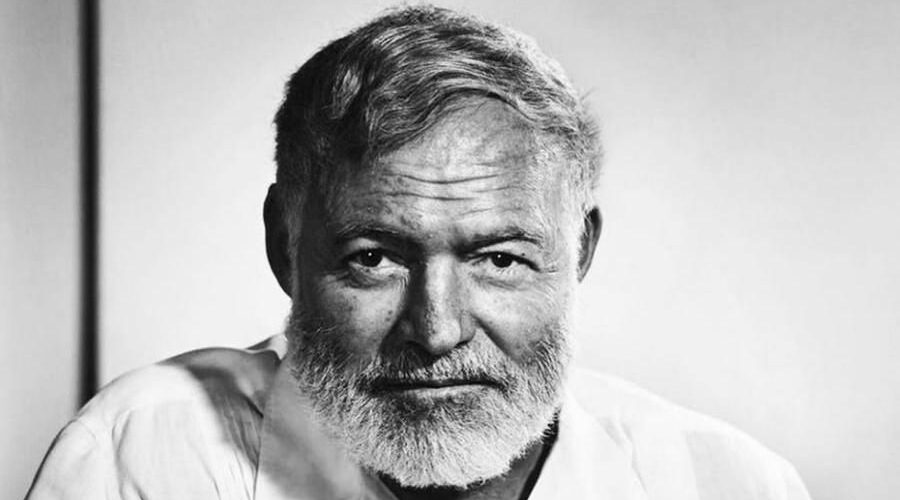
In Italy during the First World War the American writer spent a period of convalescence in Milan and fell in love with the city.
by Fabio Massimo Penna
"When we got to the bottom of the square we turned to look at the Cathedral, it was beautiful in the fog..." In the novel Farewell to Arms Ernest Hemingway pays tribute to the city of Milan. The American writer is in Italy with the task of driver of the american Red Cross ambulances and, wounded in the leg, is hospitalized in Milan, a city in which he spends a period of convalescence. Goodbye to Arms tells the love story between an American volunteer and an English nurse with the two lovers who spend a period in Milan, where the man was hospitalized for a wound. Later Hemingway returned several times to the Lombardy city, which he much loved. Love for Milan that we share and then we offer you a visit to some fascinating places of the city.
A decisive moment for the architecture of the Milanese city is the passage of Donato Bramante to Milan. Here the genius of Mount Asdruvaldo realizes both an intervention on the pre-existing church of Santa Maria delle Grazie, building the grandstand, and the construction of the small church of Santa Maria near St. Satiro. In the church of Santa Maria delle Grazie, the work of Giuniforte Solari, Bramante inserts a cubic space with a hemispherical dome and two imposing lateral absids to which a third is added on the bottom. The exterior of the building shows a harmonious coordination of the volumes in the perfect interlocking of the semi-circular grandstands of the absids and the polygonal ones of the dome. The church of Santa Maria near San Satyr is, on the other hand, embellished with the extraordinary trompe-l'oeil effect generated by the creation of a fake environment, a choir that thanks to a perspective game seems extremely wide but is actually less than a meter deep. Bramante in Milan is not just that. In the Art Gallery of Brera you can admire, in fact, his extraordinary table with Christ at the column with the figure of Jesus aching that protrudes from the painting framed in the foreground, with a powerful body that acquires volumetria thanks to the chiaroscuro that shapes a bust of classical perfection.
The visitor who enters the refectory of Santa Maria delle Grazie is impressed by the trompe-l'oeil effect of Leonardo da Vinci's The Last Supper: the perspective escape of the architecture of the fresco echoes the real one of the environment giving the impression that the room continues in the painting. This is not the only original feature of the Leonardo masterpiece. The traditional iconography included the depiction of the moment of consecration of bread and wine, and Judas sat on the opposite side of the others. Leonardo is, however, an artist who has always been interested in expressing the motions of the soul and chooses to represent the moment after Jesus' phrase: "in truth I tell you that today one of you will betray me". These words cause the disacomplied and upset reaction of the apostles: who raises his index finger as if to say "one, Lord, one?", who wears his hands to his chest meaning "Me? How could I be me?", who spreads his arms in dismay... This agitation generates an undulatory movement that runs through, starting from left to right and then e-flowing back, the figures of the apostles divided into groups of three. At the immovable center Jesus is not involved by this motion: He is alone, abandoned by his disciples to his destiny of pain. As if ruined by time, the work has been restored to its original splendor by a long and patient restoration work. Due to his executive slowness, Leonardo was not comfortable with the fresco technique that required the artist to establish in the morning the portion of fresco to be completed by the end of the day because when the plaster dried up he could no longer retain the colors. To overcome the inconvenience, the artist experimented with an innovative technique (with oil intervening on a plaster preparation) that caused, almost immediately, the deterioration of the work.
Another great architect working in Milan is the Florentine Antonio Averulino, called the Filarete. Filarete realizes theMajor Hospital,a building that has established itself as an absolute model of civil architecture over the centuries. Set as an immense quadrilateral that includes a porticoed courtyard and two square-plan bodies, the building shows a great attention to practicality due to a perfect planimetric breakdown. The facade is a brilliant fusion of Renaissance innovations and late-Gothic cues (as evidenced by the alternation of arches at all six and high-pitched).
In the Portinari Chapel inside the Basilica of St. Eustorgio,the Brescia painter Vincenzo Foppa demonstrates a perfect assimilation of Renaissance theories. Particularly in the entire sixth painting in the fresco The miracle of the rehabilitated foot the artist shows a deep knowledge of the perspective rules with the point of escape of the work that falls outside the painting creating a perfectly glimpsed image. In the religious building Foppa paints four Church doctors inside rounds inserted into plumes and four stories of St. Peter a martyr.