MILAN AND MANZONI. THE CITY IN THE WORDS OF HIS ILLUSTRIOUS SON
3 May 2020
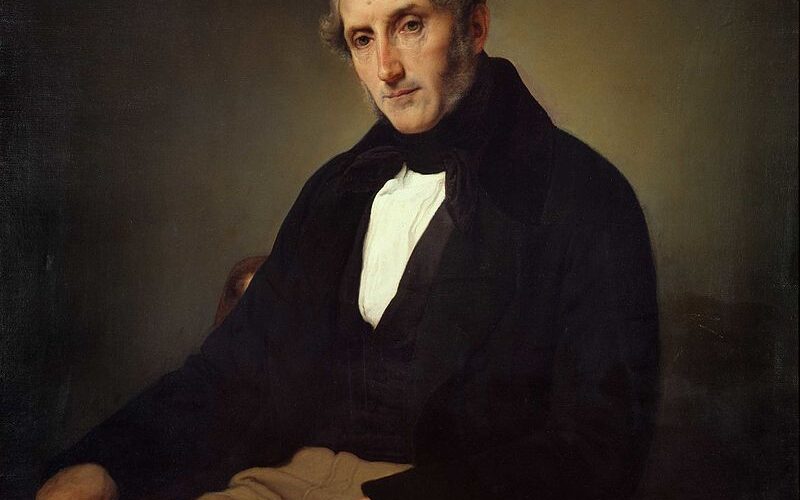
An intense relationship, never interrupted, binds Alessandro Manzoni to his hometown, that Milan that faces in The Promised Newlyweds and in all the work of the great writer.
by Fabio Massimo Penna
Milan and Alessandro Manzoni are so alone that the inhabitants of the Lombardy capital affectionately define the author of The Promised Newlyweds 'Don Lisander' (Alessandro in Milanese dialect). In fact, the writer was born and died in Milan and spent much of his life there. Here he publishes the Sacred Hymns,works atthe Adelchi, does carry out some events of The Promised Newlyweds,immerses himself in the intellectual environments of Milan... in short, its connection with the city is strong and knows no crisis of any kind. In the center of Piazza San Fedele is the statue of the writer, placed just in front of the church of San Fedele that Manzoni used to attend to gather in prayer. The home in the city center where he spent most of his life is Casa Manzoni, which houses the National Center for Manzonian Studies. And then in his masterpiece: "Renzo, who climbed for a pass on the highest ground, saw that great machine of the cathedral alone on the plane, as if, not in the middle of a city, but rose in a desert; and stood on two feet, forgetting all his troubles, contemplating from afar that eighth wonder, of which he had heard so much since he was a child" (Alessandro Manzoni, The Promised Married,Le Monnier, 1971). In the eleventh chapter of The Promised Newlyweds Renzo is enchanted to admire from afar the Cathedral, a mythical place that has been described to him since he was a child. An act of the author's love for his hometown. While Giacomo Leopardi has a conflicted relationship with his Recanati, considered the "wild village", for Manzoni Milano is, instead, the driving center where they gather and from which his physical and spiritual energies are radiated.
Manzoni's relationship with the theatre is also special. Paradoxically, the novel of The Promised Married,in the various adaptations for the stage, was represented more in the theatre than the two tragedies The Earl of Carmagnola and theAdelchi. But for theatrical theory is fundamental the preface to The Earl of Carmagnola in which the Milanese writer deals extensively with the three Aristotelian units, considering them unsuitable for modern drama. The Earl of Carmagnola is a tragedy in five acts that tells the story of the fifteenth-century leader Francesco Bussone, who is honoured in battle for the Venetian Republic before being accused of treason by the Venetian rulers and, sentenced to death, being executed to the gallows. TheAdelchi recounts the clash between Desire, king of the Longobards and Charles, king of the Franks, called by the Pope to demand the longobards the lands taken from the Church by the invaders. The refusal to make the territories occupied is triggered by war. Adelchi, Son of Desire, initially in favor of a diplomatic solution to the dispute, is forced to fight with the few men who are faithful to him. Rather than suffering the dishonour of surrender, he continues to fight for certain death.
Manzoni's vision of Catholicism is that of those who see the Church as the only institution capable of achieving the ideals of justice, brotherhood and freedom invoked by the humble classes and the people. In this spirit the Milanese writer composes the Sacred Hymns. Of the twelve planned, he writes only five: The Resurrection, The Name of Mary, Christmas, The Passion and Pentecost. Although unequal in their poetic and stylistic quality, the sacred hymns show the intent to accord Christianity with the progressive demands of the time: "De Sanctis observed that in them there was the eighteenth century 'baptized', that is, the principles of freedom, equality and fraternity, proper to the revolution French, seen in Christian light; but rightly a recent critic, Samson, pointed out that, for Manzoni, it was not just a treatment of these ideals of a religious guise. It is to find in Christianity 'the principle of every ideal' and therefore also of those proclaimed by the Revolution" (Mario Pazzaglia, Writers and critics of Italian literature-nineteenth and twentieth century,Zanichelli publisher, Bologna).
Two young people in love descended into Lombardy of the seventeenth century, an era upset by famine and plague. Born in the wake of the historical novel The Promised Married portrays a distant story in time in which you can, however, read in watermark references to contemporary Lombardy to the Milanese writer. The novel is also a celebration of the humble, the people through the figures of the protagonists from the industrious and generous Renzo to the meacious and devoted Lucia. The Church offers the creativity of Beefnian unforgettable characters: from the funny and ridiculous figure of the fearless Don Abbondio, all taken from his feeling "a pot of crock between iron pots", to the controversial character of the Nun of Monza, dough of faults and sufferings, to the courageous and morally righteous Fra' Cristoforo. The evil is represented by the local gentleman Don Rodrigo, overbearing and arrogant, perviously attached to his privileges as a caste, able to trample on any trace of Christian charity, to the terrible and tragic Unnamed While he touches the ridiculous figure of the Azzeccagarbugli, a lawyer with a smoky and dark eloquent who declares clearly to Renzo his way of understanding the profession: "The lawyer must tell the clear things: The dramatic story of the two lovers, whose marriage is fiercely opposed on a whim of the bully of the place, is illuminated by the rifts that show the intervention of the Divine Providence that always strives to help those who suffer, who lowers the powerful and lifts the oppressed.
The Manzoni poet is best remembered for two famous operas. In March 1821,the author called for the liberation of Italy from Austrian oppression in the hope of Carlo Alberto's intervention in aid of the coal movements. A separate place in Manzoni's literary production deserves the poem The May Five,written by jet after learning of the news of Napoleon's disappearance. General French had embraced the Christian faith before he died and this fact had struck the author of The Promised Married who retraces the existential path of a man who had had the fate of Europe in his hands. There is no better way to close this brief excursus in the Beef universe with the words of the poet: "Ei was. Since it is still, /given the mortal sigh, /he sted the immemorial strip/orba of so much spiro,/ so beaten, astonished/ the earth at the nuncio stands,/mute thinking about the last/hour of the fatal man."