Ferrara. THE ESTENSE CITY AND THE CINEMA WITH THE FILMS OF ANTONIONI AND VANCINI
May 14, 2020
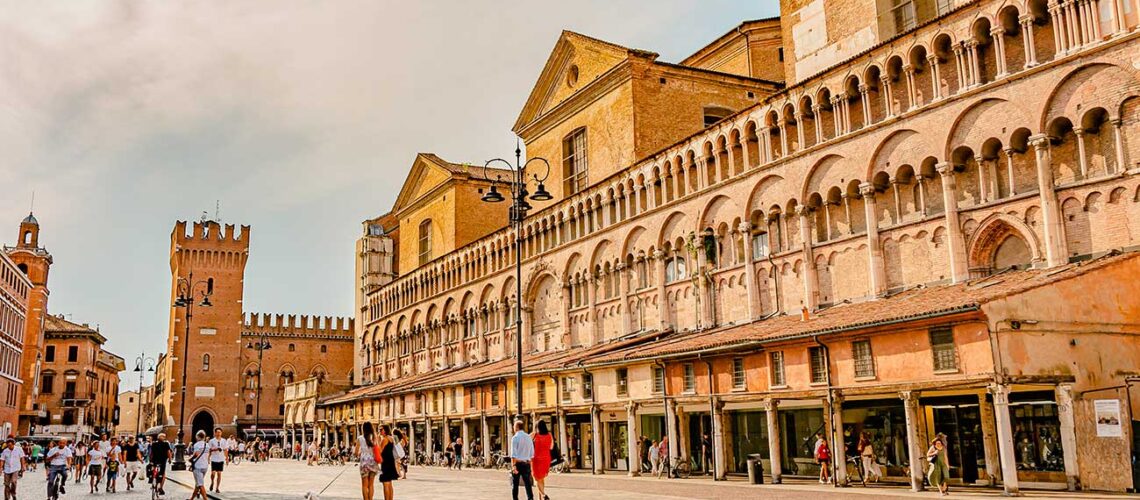
Ferrara, with Michelangelo Antonioni and Florestano Vancini, contributes to the development of the seventh art in Italy.
by Fabio Massimo Penna
Says the director of a private investigative agency to one of his detectives who is investigating a murder: "Moral, you have to go to Ferrara. The girl went to high school, she starts there." The dialogue belongs to the film Chronicle of a Love and also to retrace the career of the great director Michelangelo Antonioni (Chronicle of a Love is his first feature film) you have to start from Ferrara, where he was born in 1912. In the eastern city the young Antonioni develops a love for music, drawing, theater and attends a literary circle of which giorgio Bassani, author of The Garden of Finzi- Contini,is also part. The two write a comedy together. In Bologna, the director of L'Adventure attended university with a degree in Economics and Commerce. In Ferrara, before moving to Rome, Antonioni collaborated with the city newspaper The Courier of Padano writing about cinema. To his land the director dedicates a tribute in the documentary Gente del Po,in which he turns his attention to the moral and psychological situation of those who live on the great river straddling the Emilian and the Venetian shore. The Po, with the territories on which it faces, marks the geographical and spiritual path of the desperate worker protagonist of The Cry,also symbolizing the unstoppable current that breaks all the embankments and drives man to suicide.
Returning to Chronicle of a Love the first feature film establishes what is the stylistic figure that characterizes Antonioni's cinema: the use of the sequence plan. As Karel Reisz and Gavin Millar explain, the sequence plan is "a long, and usually rather complex, shooting, involving numerous machine movements and allowing you to film an entire scene without detachments" (Karel Resiz – Gavin Millar, The technique of film editing,SugarCo editions, Milan). In the sequence of the two lovers at the hydroscale the camera follows without ever detaching the two characters: "the whole sequence is built in a single frame a hundred and twenty-nine meters long" (Cesare Biarese-Aldo Tassone, The films of Michelangelo Antonioni, Gremese publisher, Rome, 1985). From the initial Ferrara the Antonionian geography moves(The Friends,inspired by Cesare Pavese's Among Single Women takes place in Turin) to other places of the boot before landing abroad, with the London of Blow up. From Chronicle of a Love to The Lady Without Camellias passing through The Friends and The Cry we come to the tetralogy of incommunicability(The Adventure, The Night, The Eclipse, The Red Desert)that forms the fundamental nucleus of the work of the Ferrara director. Here the investigation of feelings descends to scan inner depths to which cinema had never reached before. The spiritual emptiness in which the bourgeois protagonists of these films navigate is rendered perfectly by Claudia's character in The Adventure. Her dear friend Anna is gone, she may have died, and in her initial concern for the fate of the woman she slowly replaces a feeling of love for Anna's lover, Sandro. In the end, she is afraid that her friend may be found, which would jeopardize her relationship with Sandro. Aware of the instability, the changing nature of her feelings Claudia asks herself: "can it be so little to change, to forget? it's sad to die for." After The Red Desert Antonioni tackles the theme of the impossibility of grasping reality, of the inability of man to go beyond appearances: "The 'reality first' (the one that results from the objects that, to their appearance 'they say what they have to say ') is no longer enough: it does not matter that you feel the need to reveal -underlines Giacomo Debenedetti, who has written fundamental pages on the subject - that reality according to which is not only the theme of the new novel, but also and precisely the new cinema" (Guido Aristarco, The cinematic utopia, Sellerio publisher, Palermo, 1984). The photographer protagonist of Blow up believes that he has, thanks to his camera, filmed the scene of a murder but the reality changes, he completely escapes. He sees a corpse in a park, but when he comes back the second time, he can't find it. In the end he realizes that for him to get to know the truth is impossible and he surrenders to reality first, accepts it for what it is and stops trying to understand. The protagonist of Profession Reporter sees a truth, the rebellion of some armed groups against an African dictator, would like to make an impact in reality, enter into the game supporting the cause of the insurgents but he too remains stuck, unable to become an actor of the real world that surrounds him. In Zabriskie point the revolt against bourgeois society, the narrow consumer society, is resolved in the fantasy of the protagonist Daria who sees in his mind that world explode, disintegrate. With Identification of a woman Antonioni returns, finally, to the theme of the instability of feelings and the impossibility of creating authentic relationships between human beings.
Another Ferrara who had an important career in the seventh art is Florestano Vancini. He too, as Antonioni, began as a documentary filmmaker and dedicated his first works to the Emilian land(Delta Padano, Lonely Men). His first feature film is set in Ferrara: it is The Long Night of '43,a film based on the story present in the Five Ferrara stories by Giorgio Bassani. In a gloomy Eastern city, steeped in the rigours of winter, Vancini recounts the events of the night of December 1943 when fascist republicans arrived in the city to avenge the murder of a federal secretary and killed eleven people. An invalid who witnessed the ferocious shooting and could testify against the person responsible for the massacre decides not to speak. After the literature Vancini turns his gaze to the chronicle and in particular to the events of three boys who after fighting resistance from opposing factions (two with fascists and one with partisans) form a gang that terrorizes post-war Emilia. The film La Banda Casaroli shows a remarkable civil commitment and depicts the moment of disorientation of Italian youth after the Second World War. In The Seasons of Our Love, the moral and political crisis of the Italian left is narrated through the story of a left-wing journalist who, taken by existential anxiety, abandons his wife and visits the places where he lived his youth. Vancini confronts the past of the beautiful country by recounting a little-known episode of the Resurgence with Bronte. Chronicle of a massacre that the history books have not told. The Ferrara director looks at the story through the eyes of the oppressed and the subordinate classes inspired by a novella by Giovanni Verga. With The Murder Matteotti Vancini faces the years of the fascist dictatorship, retracing the brutal murder of the Socialist MP that turned out to be a crucial episode in Italian history.