FLORENCE. INNOVATORS AND TRANSITIONAL ARTISTS
November 16, 2020
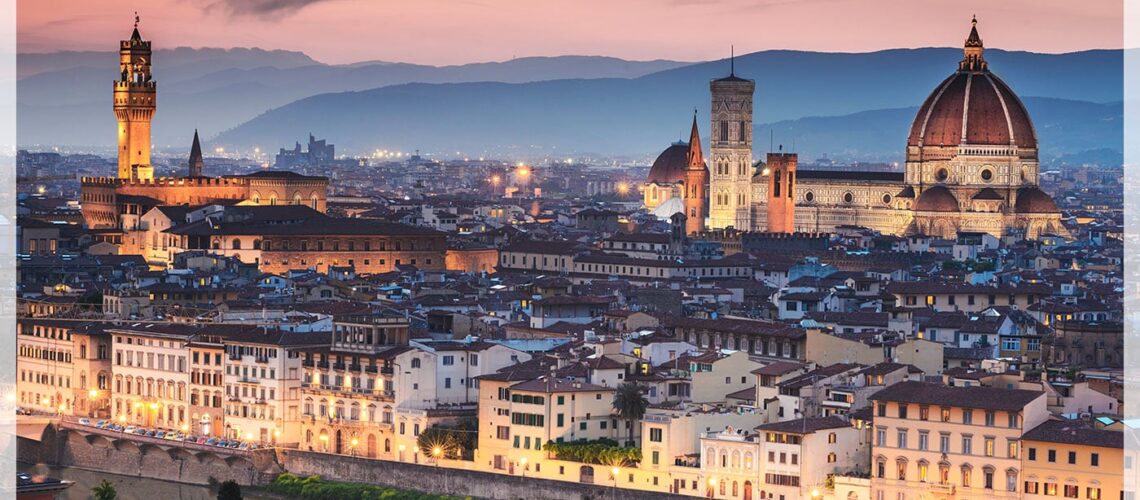
In the Tuscan city, Gothic and Renaissance coexist for a long time, while some artists, although linked to the Gothic, slowly open up to the original Renaissance proposal.
by Fabio Massimo Penna
Throughout the first part of the fifteenth century in Florence, International Gothic and Renaissance coexist. The coexistence of the two artistic experiences in the city lasts for a fairly long period while slowly the innovations proposed by Brunellesch i, Donatello and Masaccio reach other centers of the peninsula to impose a new vision of creative doing. Parallel to the practical work of the three fathers of the Renaissance, Leon Battista Alberti carries out an important theoretical activity, laying the conceptual foundations for Brunelleschi's single vanishing point perspective. His reflections on art and architecture are contained in the De pictura , in the De statue and in the De re aedificatoria . Also noteworthy is his literary production in which the Four books of the Family stand out where, through an imaginary dialogue with his relatives, he defines the family as the fundamental nucleus of social life.
Alberti is, however, also one of the greatest architects of the fifteenth century and in Florence his presence is testified by a series of masterpieces. For the facade of Santa Maria Novella , Alberti is called upon to intervene on a pre-existing structure that had been left unfinished, only the lower area having been built. The architect does not overturn the style of the work by creating a whole in which the Gothic of the lower part coexist harmoniously with the Renaissance option of the upper area, connected by a horizontal band with squares and connected by two large volutes flanking the rose window. Crowning the facade is an imposing triangular pediment. Following the Renaissance innovations, Alberti sets his intervention on modular relationships based on the square and the circle. The white and green geometric inlay cladding that runs along the facade is the element that integrates the ancient part with the modern one and refers to the outside of the church of San Miniato al Monte. Albert's theories also find expression in the facade of Palazzo Rucellai in which he combines classicism with geometric rigor. The rhythm is marked by the horizontalism of the stringcourse cornices and the verticalism of the superimposed pilasters following the order of tradition (from bottom to top Doric, Ionic and Corinthian). Another reference to the past is the opus reticolatus of the band that surmounts the hoof. In this way Roman architecture (which had also been thoroughly studied by Brunelleschi and Donatello) becomes an unavoidable model for modern constructions. The mullioned windows, a concession to medieval art, enliven the façade and lighten it. Palazzo Rucellai becomes the absolute example of residential architecture from which the great architectural geniuses of the Florentine fifteenth century drink. In the lily city Alberti also created the Tempietto del Santo Sepolcro in the church of San Pancrazio.
Together with Brunelleschi and Alberti, the other great Florentine architect of the fifteenth century is Michelozzo Michelozzi . Pupil of Ghiberti and collaborator of Donatello, Michelozzo leaves an important mark in the city. His intervention to rebuild, starting from the remains of a previous structure, the convent of San Marco shows an extraordinary ability to combine the sobriety of a monastic building with Renaissance innovations. The library, divided into aisles by the perspective escape of columns with round arches, shows a rare clarity and legibility of the architectural structures. Michelozzo also designs Palazzo Medici-Riccardi . Derived from the Florentine tradition of fortress-houses, Palazzo Medici-Riccardi looks like a cube-shaped structure enlivened by the use of both rustic and smooth bugno in the façade and lightened by the sequence of mullioned windows. Also noteworthy is the internal courtyard with a portico punctuated by round arches on Corinthian columns and adorned with friezes and festoons. This building, like Palazzo Rucellai, achieved extraordinary success by establishing itself as a residential model for the Florentine urban aristocracy.
In the lily city there are not only gothic artists and Renaissance innovators but also geniuses who try to harmonize the two experiences in their work, placing themselves as a bridge between the two ways of making art. Masolino da Panicale has the opportunity to work side by side with the innovator Masaccio, from the paired table in the Sant'Anna Metterza degli Uffizi to the frescoes in the Brancacci Chapel in Santa Maria del Carmine. In relation to this last collaboration we have already highlighted, in a previous article, the stylistic differences between Masaccio's Expulsion of the progenitors and the original Masolinian Sin . The fresco of Herod's Banquet in the Baptistery of Castiglione Olone, made after the collaboration with the painter of San Giovanni Valdarno, shows a gradual insertion of the linear centric perspective within a composition still linked to the elegant and graceful ways of the Gothic . The Florentine years left a notable trace in Masolino's style.
An important figure of the fifteenth century, although not involved in the Renaissance revolution, is that of Lorenzo Ghiberti , an artist competing with Brunelleschi both for the competition for the second door of the Baptistery and for that for the dome of Santa Maria del Fiore. Even in his transitional work, Brunelleschi's perspective of a single vanishing point coexists with Gothic refinements in a slow but constant opening to the new. Ghiberti also carries out an important theoretical activity as evidenced by the treatise I commentaries . Its door of the Baptistery of Florence, admired by Michelangelo who defines it as the door of Paradise , shows in the panel with The meeting of the Queen of Sheba with King Solomon a precise framing based on the linear centric perspective particularly visible in the escape of the columns of the architectures in the background.