BRESCIA. THE RENAISSANCE IN THE LOMBARD CITY
November 16, 2020
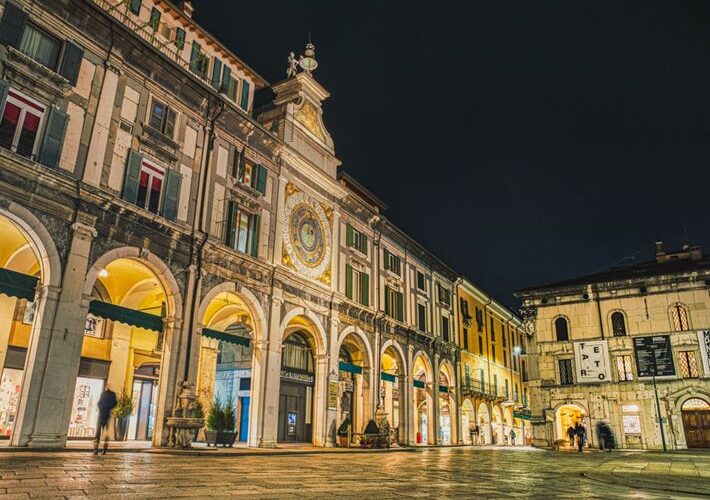
With Foppa in the fifteenth century and with Moretto, Romanino and Savoldo in the sixteenth century, Lombardy expresses its own version of the Renaissance.
by Fabio Massimo Penna
Brescia in the sixteenth century has its own declination of the Renaissance thanks to prominent personalities such as those of Alessandro Bonvicino known as Moretto , Gerolamo Romani known as Romanino and Giovanni Gerolamo Savoldo . In their works, the three artists announce Caravaggio in the light that redeems the figures from the deep darkness in which they are immersed. They also portray "a difficult and harsh humanity that exposes the shadows of its interiority to light" (Flavio Caroli, The history of art told by Flavio Caroli , Electa editrice, Milan, 2001). The Lombard Caravaggio finds his roots in the works of fellow countrymen with whom he shares a cultural humus that spread in Lombardy between the sixteenth and seventeenth centuries. Moretto, Romanino and Savoldo opt for an anti-rhetorical representation, without unnecessary embellishments, for a raw and concrete realistic rendering.
The declination of Romanino's naturalism is grafted on the knowledge of Tiziano's tonalism, so that Lombard truth is wrapped in a chromatism of Venetian ancestry. However, his consonance with Caravaggio is fundamental, as evidenced by the comparison between the San Matteo del Romanino of the Brescia Church of San Giovanni Evangelista and the first version of the Caravaggesque San Matteo e l'angelo since both works share the revolutionary rough aspect of the saint , depicted barefoot with filthy feet. In the Church of San Francesco in Brescia there is his altarpiece Madonna with Child and Saints with the Brunelleschi barrel vault framed in perspective and the Virgin and Child placed on a high base surrounded by saints and devotees while a cloth held up by two angels holding the curtain it hides the landscape and behind the figures you can hardly see a leaden and cloudy sky. Important traces of Romanino's work can be found in Trento where in the Buonconsiglio Castle he created some of the frescoes that decorate the residence of Bishop Bernardo Cles (among the other authors of the frescoes also the brothers Dosso and Battista Dossi). In the Cathedral of Cremona Romanino realizes the fresco The Passion of Christ , a work that announces the Baroque theatricality in a set of classical architecture and figures characterized by an all-Lombard realism.
Savoldo from Brescia, keeping Vincenzo Foppa's work as a solid reference point, turns his gaze to Venetian tonalism, and to Giorgione in particular, as demonstrated by the canvases he dedicates to Maddalena (an important version of the work is kept at the National Gallery of London) in which an extraordinary cobalt night sky finds its counterpart in the luminous gray of the woman's mantle while Magdalene stares at the viewer involving him in the painting. The realistic choice is accompanied here by an acute psychological analysis of the portrayed character, whose inner motions are highlighted. With the figures of the angel and the saint emerging from the shadow of St. Matthew and the angel of New York anticipates the Caravaggesque style while great technical skill shows the Portrait of a man in armor in the Louvre with the image of the portrayed character reflected in two mirrors. In Brescia, at the Tosio Martinengo art gallery, you can admire the Portrait of a young flutist and the Adoration of the shepherds . Also in the Tosio Martinengo Art Gallery there are two masterpieces by Moretto. The Rovelli altarpiece frames in a diagonal perspective the Madonna and Child seated on a high base (evident the reference to the Titianesque Pesaro altarpiece ) and Saint Nicholas presenting some children to her. There is also an architecture taken from the front framed by a round arch that defines a deep niche. The cold chromatism of the work and the definition of the rich details of the garments of the Virgin and the saint are remarkable. In Christ and the Angel the color changes towards dull colors in a work of high pathetic value with the figures staggered on the steps of a staircase with a dejected Christ in the foreground and a sorrowful angel holding a curtain in the background.
Previously, in the fifteenth century, Brescia had given birth to a great painter such as Vincenzo Foppa . Foppa had been one of the artists of the north who had best assimilated Renaissance perspective theories. His great skill in this sense is demonstrated, in the church of Sant'Eustorgio in Milan, by the extraordinary perspective layout of the fresco The Miracle of Narni (notable above all in the rendering of the vault of the barrel arch under which Saint Peter martyr is found and the miraculous) with the vanishing point falling outside the frescoed area. The same perspective perfection is shown by the Pala Bottigella di Pavia. Renaissance novelties and Paduan archaeological taste of Mantegnesque origin come together in the Three Crucifixes of the Bergamo Academy of Carrara. The Pala della Mercanzia is preserved in the Tosio Martinengo Art Gallery in Brescia, another example of perfect understanding of the central perspective.