NAPLES. THE GULF, THE VESUVIUS AND THE ARTISTIC BEAUTIES.
7 December 2020
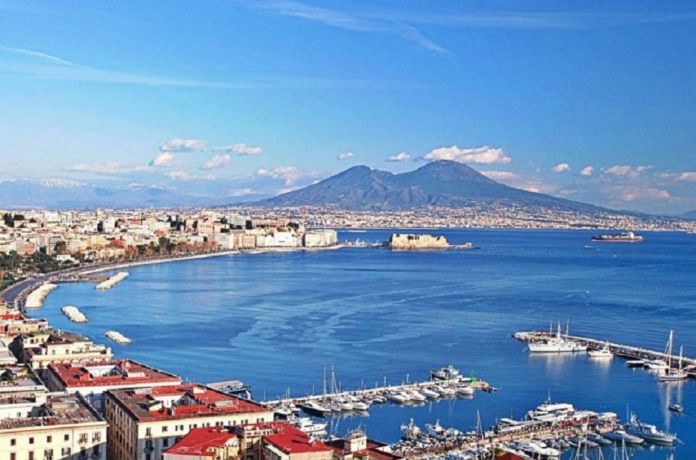
A city of extraordinary beauty, Naples presents artistic masterpieces ranging from Iberian influences to Renaissance interventions to Baroque theatricality.
by Fabio Massimo Penna
Naples was once considered one of the most beautiful cities in the world. The gulf, Vesuvius, the port and the urban districts enchanted visitors. A great Mediterranean metropolis that combines the splendor of the place with the liveliness of the inhabitants, a swarm of life and history in an immense blue. For our itineraries we choose some artistic places, among the many offered by the Neapolitan city, of particular interest.
In the fifteenth century in the Neapolitan city are found to work workers from Spain under the direction of the great Catalan architect and sculptor Guillén Segrera , who arrived in Naples in 1447. His name is linked in particular to the triumphal arch of Alfonso of Aragon , a monumental entrance that combines architecture and sculpture with extraordinary naturalness. The work derives from antiquity, drawing inspiration from the Roman triumphal arches. Set between two towers, the structure is set on two superimposed round arches and is closed in the upper area by a curvilinear tympanum, containing a high relief with two river gods, above which the statue of the archangel Michael stands out. The height of the two arches is separated by the Triumph of Alfonso, a frieze with bas-reliefs while some niches contain statues representing the cardinal virtues. The work seems to lack compactness due to the interventions of various sculptors among which the Dalmatian Francesco Laurana , who since 1452 directed the work of the triumphal arch. According to a tradition, the great artist Pisanello, present in the Neapolitan city at the time, also contributed to the realization of the work. The end of the century saw the Renaissance theories elaborated in Tuscany by geniuses such as Brunelleschi, Alberti, Masaccio, Donatello and Piero della Francesca arrive in Naples.
An absolute masterpiece of this phase is the sepulcher of Maria d'Aragona in the church of Sant'Anna dei Lombardi, a typical wall monument of the Renaissance. The work, begun by Antonio Rossellino and completed by Benedetto da Maiano , is inspired by the monument of the Cardinal of Portugal built for the Florentine church of San Miniato al Monte by Rossellino himself a few years earlier. The burial of Maria d'Aragona is presented as a sample of the repertoire of classical ornamental and architectural elements. The sculpture of the deceased is lying on a sarcophagus at the sides of which sit two funerary geniuses. Another fundamental work for the Neapolitan Renaissance is the villa of Poggioreale which sees the intervention of two great architects such as Giuliano da Maiano and Francesco di Giorgio Martini . Another Neapolitan triumphal arch is also due to Giuliano da Maiano, the Porta Capuana , a structure with perfect proportions and decorated in an extremely refined way. Of extraordinary quality is the exceptional sculptural group in polychrome terracotta the Lamentation over the body of Christ by Guido Mazzoni preserved in the church of Monteoliveto.
During his escape from Rome after the murder of Ranuccio Tomassoni and the consequent death sentence in absentia, Caravaggio stopped on two occasions in Naples (in 1607 and 1609) and left important artistic traces of his passage in the city. In 1607 he created an extraordinary work such as The Seven Works of Mercy preserved in the church of Pio Monte della Misericordia. The canvas is dramatically animated with characters, theatrically characterized by a frenetic gesture, which emerge from the darkness in which the painting is immersed. The representation of a sacred theme is innervated by the humanity and passion characteristic of the Neapolitan reality. The work has the peculiarity of representing the works of evangelical mercy together in a single canvas. They are figurations of high symbolic value as in the case of a woman intent on breastfeeding an elderly person (feeding the hungry) or in the Saint Martin covering a naked figure with her cloak (dressing the naked). On the other hand, it is difficult to establish whether the extraordinary Flagellation preserved in the Capodimonte Museum is to be attributed to the first or second Neapolitan stay of Merisi.
Among the many beauties of Naples, the eighteenth-century Foro Carolino by the great architect Luigi Vanvitelli deserves a visit, an important urban intervention based on classic austerity that reveals the eclecticism of the great architect, urban planner and civil engineer.