ROME. THE LONG EVENT OF THE SAN PIETRO FACTORY
8 December 2020
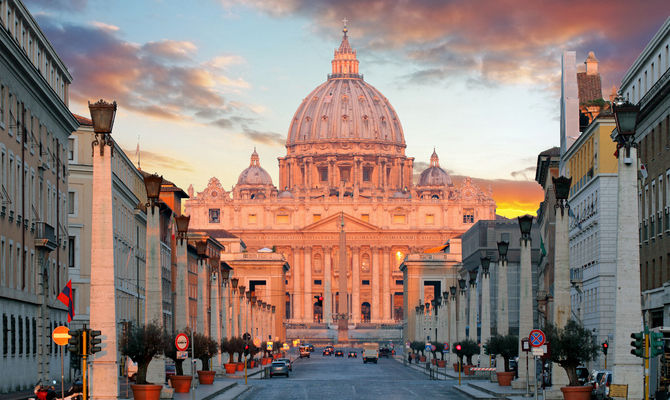
St. Peter's Basilica sees the light with interventions by many artists, from Bramante to Raphael from Antonio da Sangallo to Michelangelo, and disagreements between designers and clients.
by Fabio Massimo Penna
In the fifteenth century in Italy the question of the central plan assumed a fundamental role in the field of art and architecture. The Pantheon and some early Christian constructions such as the Roman church of Santo Stefano Rotondo are used as reference models. Once the longitudinal development of the ecclesiastical buildings was excluded, the theory envisaged the adoption of the figure of the circle considered the ideal form: "Marsilio Ficino even entrusted the analogical presentation of God to the circle, as well as the dome, which concludes the building with a central plan it is assimilated to the sky according to an ancient religious symbolism ”(Pierluigi De Vecchi-Elda Cerchiari, Art in time , Fabbri publishing group, Bompiani, Sonzogno, Etas spa Milan, 1991-1992). The circle therefore can symbolize the sky, its immutable circular movement and divinity. Leon Battista Alberti lays the theoretical foundations of this artistic research in his treatise De Re Aedificatoria, who defines the central one as the ideal plant for the church-temple. The studies on the central plan thrill Donato Bramante who brings this architectural model to perfection in his Tempietto di San Pietro in Montorio. The small building, built on the spot where it was thought that Saint Peter was crucified, with its central plan and cylindrical shape becomes for the architect of Monte Asdruvaldo the starting point for the project of the new basilica of Saint Peter . Pope Julius II had developed the conviction that the ancient Basilica of St. Peter should be rebuilt and in 1506 he decided to demolish the now outdated old basilica and build a new one. Bramante was in charge of supervising the works for the new cathedral.
In reality, the construction of the new St. Peter's Basilica turns into a long and tormented story. Bramante's idea of adopting a Greek cross on which to set an imposing central dome was opposed by the ecclesiastical authorities. The highest representatives of the Church are reluctant to abandon the Latin cross plan because this allows the faithful to be aligned in an orderly manner in front of the officiant. The longitudinal plan, experienced by a long building tradition, seems to the ecclesiastics to offer guarantees of better functionality compared to the Latin cross. The architect from the Marches did not have an easy life and "the work, which began on April 18, 1506, proceeded slowly under the direction of Bramante until 1514 but later the project underwent radical transformations and the longitudinal basilical layout was re-proposed" (Pierluigi De Vecchi -Elda Cerchiari, op.cit.). On the death of Bramante, the direction of the works was entrusted to Raffaello Sanzio who, faced with the pressing requests of the clients, returned to the traditional Latin cross plan. 1520 saw the death of the "Divine painter" and the superintendence of the San Pietro factory passed to Antonio da Sangallo the young man who tried to achieve a compromise solution between the two previous projects, returning to the central Bramantesque plan but adding a forepart that the 'approaches the longitudinal structure. This is an impractical and confused idea that does not convince the ecclesiastical authorities.
To definitively resolve the question of St. Peter's Basilica, Michelangelo Buonarroti was called to intervene. The author of the frescoes in the Sistine Chapel returns without hesitation to Bramante's solution, the only one acceptable in his own words: "Anyone who has departed from said order of Bramante, as did Sangallo, has deviated from the truth" (in Pietro Adorno-Adriana Mastrangelo, On art and artists , D'Anna publishing house, Florence, 2002). The obstinacy of the Curia ends, however, by also ruining Michelangelo's intuition. In fact, Carlo Maderno will be called to retouch Buonarroti's project with the addition of a forepart which, by moving the dome away from the center of St. Peter's Square, diminishes the effect of grandeur. The long and troubled history of the San Pietro factory ends with the last interventions of Gian Lorenzo Bernini who arranges the square and creates the canopy and the chair in glory inside the Basilica.