VOLTERRA. ETRUSCAN ART MEETS MANIERISM
21 December 2020
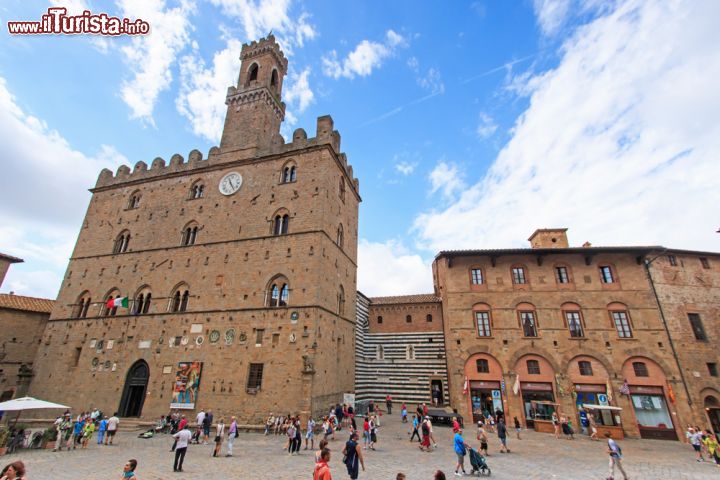
A city rich in history and art, Volterra was also the mythical place where Carlo Cassola set many novels.
by Fabio Massimo Penna
Hometown of the artist Daniele Ricciarelli, known as Daniele da Volterra , a painter whose fame was compromised by the task of covering the Michelangelo's nudes in the Sistine chapel which earned him the derogatory nickname of "braghettone", and a mythical place in which the Roman writer Carlo Cassola sets his literary works, Volterra imposes itself on the visitor as one of the most beautiful Tuscan centers. Superb example of integration between medieval urban planning and Etruscan and Roman ruins, the city stretches out at an altitude of 550 meters on a hilly area characterized by crags with underlying badlands, characteristic local geological formations. The city center is enclosed within Etruscan and medieval walls. Volterra was initially one of the twelve Etruscan city-states. Situated in a favorable strategic position, it controlled a vast coastal strip and, subsequently, passed under the Roman jurisdiction. The moment of maximum splendor the city reached it, however, during the Middle Ages. If the structure of the urban center can be traced back to the Middle Ages, there are many remarkable remains from the Etruscan and Roman periods. Starting with the arch door , a typical Etruscan example of a royal arch, with the subdivision of the weights with the load on the keystone which is unloaded on the lateral ashlars. The masonry consists of large square stones. Although subjected to interventions in Roman and medieval times, the work maintains its original shape with the pillars made of sandstone and the rough stone ashlars. Of exceptional beauty and historical value are the remains of the Roman theater of the Augustan age, characterized by a steep semicircular area for spectators resting on the side of the hill with the orchestra and stage at the bottom.
A must for those who go to Volterra is, of course, the Guarnacci Etruscan Museum , named after Monsignor Mario Guarnacci , who in 1761 donated one of the most important collections of Etruscan art in Italy to his native city. The museum can boast more than six hundred cinerary urns and remarkable votive bronzes. The extensive collection, which has grown over time thanks to excavations and acquisitions, ranges from Villanovan works to Hellenistic finds. Dominating the city skyline is the Rocca Nuova , a fortification commissioned by Lorenzo the Magnificent, which over time became a prison. Another unavoidable visit is that of the Palazzo Pretorio which, consisting of the union of several buildings and a tower, is punctuated by a series of mullioned windows inscribed in a pointed arch and is characterized by the boar depicted in the upper area. The tower was used as the office of the mayor, the highest city judge. Also noteworthy is the octagonal Baptistery of the Romanesque era made with the local stone with white and green stripes. Romanesque art, declined in the Pisan style, is attributable to the Cathedral of Santa Maria Assunta with three naves which, while maintaining a traditional appearance, appears as an uneven work.
The Civic Museum preserves a very famous work such as the Deposition by Rosso Fiorentino , one of the greatest masterpieces of Mannerism. Played on the vertical lines of the cross and the three stairways leaning against it, a sort of framework for the composition, the table hides the landscape in the background due to the excited crowding in the foreground of the serpentine figures (elongated like the flame of the fire that hovers in aria), characterized by expressionistically distorted faces, and by a leaden and livid sky. The whole is characterized by a mixture of the real and the abstract. The enthusiasm of the gestures and the angular outlines accentuate the pathetic and melodramatic note of the painting.
Not an excellent artist, Daniele da Volterra works in Rome in the circle of Michelangelo. An important friendship which, however, will become a negative mark for the artist from Volterra called to cover the nudes of the Last Judgment . In the Eternal City Daniele leaves important traces of his adherence to Mannerism, in particular in the crowded Deposition of Christ from the cross of the Orsini Chapel in the Church of Trinità dei Monti where the memory of Rosso Fiorentino's Deposition of Volterra is evident. Here too the arms of the cross and the three stairs leaning against it create a grid around which the figures are arranged, whose number appears to have increased compared to Rosso's model. In the same Roman church you can also admire The Presentation of the Virgin in the Temple in the Della Rovere Chapel.
A great love binds the Roman writer Carlo Cassola to Volterra. The scholar's mother was born in the Tuscan city and he spent many periods of his life there. Its participation in the resistance is linked to the XXIII brigade which acted in that area of Tuscany. In Volterra Cassola sets many of his literary works such as La ragazza di Bube , Fausto and Anna and The old companions .