ROME. WE ADMIRE THE SPLENDOR OF RAFFAELLO'S VATICAN ROOMS
December 16, 2020
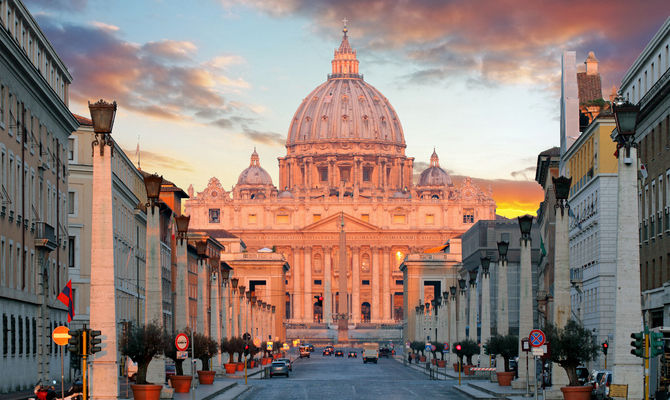
The Divine Painter of Urbino conquers Rome with his unattainable art, leaving absolute masterpieces such as the Vatican Rooms.
by Fabio Massimo Penna
They are called predestined. When Pope Julius II, probably on the advice of Bramante, calls Raffaello Sanzio to join the group of painters who decorate the Vatican rooms, no one imagines what is about to happen. The dream team wanted by the pontiff made up of Perugino, Sodoma, Peruzzi, Bramantino, Lotto and Johannes Ruysch is ousted by the young Urbino. The Pope sees the first pictorial interventions of the Urbino area, is struck by the quality of his hand and decides to entrust the entire decoration of the complex to him alone. A predestined, in fact, Raphael who with his greatness obscures all other painters. His presence in Rome is attested since 1509 and in the Eternal City the "Divine Painter" became the favorite artist of the Pope, the clergy and the Roman nobility, so much so that his death in 1520 left "this (pontifical) court in great and universal mestitia ”as underlined by the art collector and scholar Marcantonio Michiel. So much admiration was definitely deserved if only for the extraordinary School of Athens , fresco in the Stanza della Segnatura, in which the spectacular piece of architecture framed in perspective is the background to a crowd of ancient characters among which the philosophers Plato and Aristotle surrounded by Euclid, Diogenes, Socrates, Pythagoras, Epicurus and many others. If the perfect and powerful construction drawn into perspective leaves the beholder breathless, the figures, divided into groups and deeply grooved, show an amazing gallery of portraits in which the thinkers of antiquity take on the appearance of contemporary artists such as Lenardo (Plato ), Bramante (Euclid), Michelangelo (Heraclitus) while Raphael himself portrays himself in the young man next to Sodom on the right of the fresco. The architectural structure that frames the work refers to the Roman constructions and the projects that the fellow countryman Bramante carried out for San Pietro. The idea that inspires the artist seems to be that of representing the temple of wisdom.
In the signature room there is also another Raphaelesque jewel: the fresco with the dispute of the sacrament . The consecrated host is the point where the perspective lines converge and is also the symbolic center of the work as it represents the mystery of the Eucharist. Two worlds converge in the painting, that of the triumphant Church with the saints and apostles arranged on a cloud around Jesus and the militant Church, in the lower area, with theologians, preachers and writers immersed in an earthly landscape. The classical (divine) measure allows the artist to organize vast and complicated compositions in a harmonious way demonstrating an impeccable assimilation of the Renaissance pictorial manner. In this room you can also admire the Parnassus . The composition shows Apollo intent on playing the arm lyre surrounded by the Muses and ancient and modern poets. The fresco exalts the ideals of beauty and classicism but is affected by a declamatory and rhetorical stamp foreign to the overall style of the rooms.
Another extraordinary fresco is The expulsion of Heliodorus from the temple (room of Heliodorus) marked by the vertiginous perspective flight of the arches and columns of the grandiose building in which the profaner of the temple of Jerusalem is overwhelmed by a divine knight. The work underlines the faculty of the Church to possess earthly goods in a period of complex relations between the clergy and the laity that precedes the tragic events of the sack of Rome in 1527. It is a work characterized by agitated movements, by whirling actions that show the artist's turning towards a pronounced drama. The room of Eliodoro also hosts The liberation of St. Peter from prison , an episode that the artist divides into three scenes (an angel frees the saint, the angel and Peter come out of the prison, the guards who had fallen asleep are violently awakened by others soldiers) who are held together by the light that pierces the night darkness.
The Mass of Bolsena is also found in the Stanza di Eliodoro. It is a work that opens to the miracle with the representation of an extraordinary event that occurred in Bolsena in 1263, when a skeptical Bohemian priest saw blood gushing from a consecrated host. The fresco exalts the devotion that Pope Julius II paid to the sacrament of the Eucharist. Also in this case the scene is characterized by an imposing architecture exemplified by the concave wooden choir in the shape of a hemicycle which occupies the central area of the work and which, with its bulk, hides the landscape in the background. In front of this mighty structure there is the altar with on one side the priest who exhibits the host from which the blood flows and on the other the Pope Julius II kneeling in prayer.
In the fire room of Borgo there is the homonymous fresco that refers to a fire that occurred near the Vatican in the year 847 miraculously tamed by Pope Leo IV. It is believed that the work is largely due to the help of the Divine Painter, especially Giulio Romano and Giovanni da Udine . The lively theatricality of the scene depicted with the reference to the Aeneid in the left area with Aeneas carrying his father corresponds to the great scenographic value of the buildings (the Serliana from which the Pope looks out is remarkable) and the escape of the Corinthian columns in the foreground. Anchises on his shoulders followed by his son Ascanio and with the desperate crowd of figures fleeing the burning buildings. To give compactness to the whole is the vanishing point placed at the height of the mosaics of the church facade in the background.