BRERA ART GALLERY. IN MILAN A CASKET FULL OF MASTERPIECES
28th April 2020
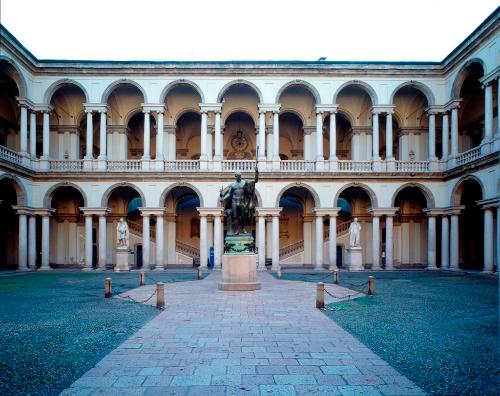
For art lovers Milan offers an exciting route in the Pinacoteca di Brera that hosts an extraordinary amount of artistic masterpieces.
by Fabio Massimo Penna
A trip to Milan would be incomplete without a visit to the Pinacoteca di Brera. The museum is located on the first floor of the Brera Palace, which was founded as the headquarters of the Academy of Fine Arts and is home to a large number of masterpieces by artists, mainly Italians. Let's see some of them.
Extraordinary example of Andrea Mantegna's perspective mastery is the dead Christ defined at the time christ as "in care", referring to the impeccably glimpsed body of Jesus lying on the stone of aging. The perspective at a single point of escape is not, however, applied rigidly but flexibly so that the artist of Isola di Carturo excludes the head of Jesus from the framed, enlarging it to avoid unpleasant effects of disproportion and disharmony. For the same reason there is another optical correction in Christ's feet smaller than they should be. The close-up vision and powerful glimpse of the figures give the canvas a high dramatic vehemence.
Piero della Francesca's Brera shovel is one of the fundamental works in the history of Italian art. Here the use of perspective and the incidence of light make the table a perfect example of the integration of figures and architecture. The characters depicted are arranged around the Virgin with the Child following the curve of the painted apse. Thanks to the light that bathes them by letting them out of the shadow areas the figures take on relief and detach from the bottom giving depth to the painting. An ostrich egg (symbol of the rebirth of Jesus) hangs on the head of Our Lady, of which the oval replicates. The work is set to a strict geometry based on the figure of the circle defined by the arch to the entire sixth of the apse and taken at the bottom by the characters depicted. The importance that Piero della Francesca attaches to geometry is borne out by his writings: De perspectiva pingendi, Libellus de quinque corporibus regularbus e De abaco.
Among the highest moments of Italian painting there is a kind of "race" between Piero Perugino and his student Raphael Sanzio in painting the subject of The Marriage of the Virgin. The two works are made between 1500 and 1504. Both set in a square closed at the bottom by a temple with the figures of the protagonists in the foreground in the center of the painting, surrounded by witnesses. The religious construction, which in the painting of Perugino loomed behind the figures and was cut off from the image at the top of the dome, is moved back by Raphael and made the centerpiece of the composition. The characters of the Urbinate also show a greater naturalness than the static characters and artifacts of Perugino. The vanishing point to which all prospect lines converge is placed by Raphael at the temple door. The Art Gallery of Brera preserves the work of the Urbinate while The Marriage of the Peruginesee Virgin is located in the Musée des Beaux-arts of Caen.
Caravaggio's Emmaus dinner at the Art Gallery of Brera is the second canvas that Merisi dedicates to this sacred subject (the other is at the National Gallery in London). It is one of the first works made by the painter after escaping from Rome. The Lombard artist had killed this Ranuccio Tomassoni after a game of ball and, because of the powerful family of the latter with the Spanish authorities, had to give himself to the escape. The first stages of a wanderer that will take him to Naples, Malta, Sicily and Tuscany are the possessions of Prince Colonna near the capital: Palestrina, Paliano, Zagarolo. The work of the Art Gallery of Brera is painted in Zagarolo or Palestrina. Here, as often in Caravaggio, the figures emerge from the shadow and amazement of the two apostles in learning that the mysterious walker sitting in front of them is Jesus risen perfectly by the disciple who still with his hands at the table, as if to avoid falling for the upheaval created by revelation. The light that frees the characters from the semi-darkness that swallows them, their expressive gestures and the discharge of still life on the table characterize a painting of deep psychological investigation and effective essentiality.
The impressive canvas of Tintoretto The discovery of the body of San Marco confirms, in the amazing prospective escape of the arches, in the glimpse of the corpse of the saint, in the skilful play of lights and shadows, that attitude to the spectacular and extraordinary theatricality of the Venetian painter. The pictorial virtuosity is accompanied by a great ability to arouse the emotional participation of the concerner.
Painting-symbol of the Art Gallery of Brera is The Kiss by Francesco Hayez. The work has a high allegorical value: the depiction of the resurgent patriot at the moment when, called to leave for war, he bids farewell to his beloved also hides a political meaning. The colors of the clothes of the volunteer and those of his woman, fused in a tender embrace, are those of the flags of Italy and France and the work thus seals the alliance between the two nations. The Milanese museum also preserves another painting-emblem of Hayez: The Portrait of Alessandro Manzoni,with the author of The Promised Newlyweds caught three-quarters in a thoughtful attitude.
Giovanni Bellini is the painter who lays the foundations for the birth of tonal painting (it will then be Giorgione who eliminates the preparatory design and paints directly on the canvas). In fact, he is credited with the discovery of the chromatic perspective: the warm colors approach the viewer, the cold ones move away. The Pieta of the Art Gallery of Brera shows in the foreground our Lady, Christ and St. John shot at half-mast while the landscape in the background is immersed in a bruising sky. The figures are characterized by a sculptural definition of the bodies of Mantegnessnic ancestry and a attention to detail that brings him closer to the Flemings (the curls of St. John's hair are painted with maniacal care).
One of the greatest masterpieces of Futurist painting is present in the Art Gallery of Brera: Brawl in the gallery of Umberto Boccioni. The work shows, in the touches of color, the imprint of the important divisionist period of the artist, to which is added the research on movement and dynamism typical of futurism. The canvas depicts the scuffle between two women around whom an agitated crowd gathers that creates a centripeto bike that flows into a spot in the middle of the two quarrels. Metaphysical works such as Carlo Carrà's The Metaphysical Muse and Giorgio Morandi's Still Nature can also be seen in theMilanese museum, both of which are characterized by the sense of suspension and estrangement characteristic of the works of the painters of the movement created by Giorgio de Chirico.