FLORENCE AND THE THREE FATHERS OF THE RENAISSANCE. THE INNOVATIONS OF BRUNELLESCHI, DONATELLO AND MASACCIO
November 15, 2020
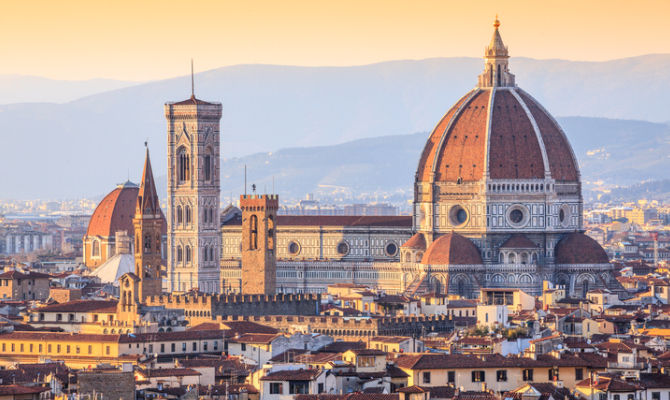
The beginning of the fifteenth century saw the Tuscan capital as a witness to the innovations that changed the world of art forever.
by Fabio Massimo Penna
What happens in the artistic field in Florence at the beginning of the fifteenth century is a real Copernican revolution. The discovery that definitively changes world art is that of the central perspective, the perspective at a single vanishing point, by the Florentine architect Filippo Brunelleschi . Such is the extent of Brunelleschi's conquest that to date no better system has been found to represent reality in works of art. The Tuscan genius immediately found highly valued followers in sculpture ( Donatello ) and painting ( Masaccio ). The three initiate the Renaissance, perhaps the era of greatest splendor of art in the world. In the fifteenth and sixteenth centuries, in the Medici era, Florence and Tuscany were the scene of a unique event, never happened before and that will never be repeated, namely the birth of an impressive number of artistic geniuses: from Beato Angelico to Filippo Lippi, from Andrea del Castagno to Antonio del Pollaiolo, from Luca della Robbia to Botticelli, from Verrocchio to Ghirlandaio, from Leonardo to Michelangelo, just to name a few.
The signs of the great turning point come at the beginning of the century thanks to the evidence presented by "Ghiberti and Brunelleschi at the competition launched by the art of Calimala (the guild of draperies) to choose the artist to whom to assign the north door of the baptistery" ( Pierluigi De Vecchi-Elda Cerchiari, Art over time - From the Late Gothic to Rococò , Fabbri, Bompiani, Sonzogno, Etas, Milan, 1991-92 publishing group). The job was awarded to Ghiberti but the panel with the Sacrifice of Isaac by Brunelleschi already shows the qualities of an innovative and original genius who manages to give the bas-relief a sense of depth. Furthermore, an unusual fact, some figures go beyond the limits of the frame. The challenge between the two artists does not end here, since in 1418 the two took part in the competition for the dome of Santa Maria del Fiore, winning it ex-aequo. In fact, however, Brunelleschi alone directs the work on the site. It is one of the most important commissions of the fifteenth century as the city authorities wanted a dome so high as to dominate all of Tuscany.
In those same years the Florentine architect also laid the foundations for his perspective theory, which provided for the confluence of all the orthogonal lines in a single vanishing point. This method allowed to give a painting (or a sculpture or a building) a great compactness and homogeneity, especially in comparison with many works of previous eras in which the viewer's gaze was lost among many disconnected details in a fragmented and disunited vision. The representation of reality through this linear centric vision allows you to groove figures and objects in depth so that the dimensions of what is close to the relative are greater (according to geometric and mathematical rules) than what is distant. The theoretical basis of Brunelleschi's discovery is provided by Leon Battista Alberti who in the treatise On Painting describes the method in detail.
To absorb almost completely the mental energies of the Tuscan genius was, however, the construction of the dome of Santa Maria del Fiore . The construction of the cathedral had been abandoned in the fourteenth century after the construction of the tambour and there was no possibility of making the céntine, the wooden armours that could support the dome during the works. Brunelleschi conceived a system of mobile scaffolding and the arrangement of the bricks in a herringbone pattern, thus obviating the difficulties that until then had seemed insuperable. It obtains a great stability of the building by conveying the tensions and weights of the building to the center of the dome, in correspondence with the lantern which conveys all the weights in its downward thrust giving stability to the structure. Another Brunelleschi masterpiece is the Old Sacristy in the church of San Lorenzo, a square room designed in a rational way, with all the parts connected in the center by a perfect mathematical relationship and crowned by a raised sixth dome divided into twelve parts by ribs. The interior is decorated with elegant architectural elements in pietra serena and Corinthian pilasters. Extraordinary is also its facade with portico of the Spedale degli Innocenti with nine round arches on columns, with nine spans based on precise modular relationships. The glazed terracotta tiles by Luca Della Robbia adorn the whole. Among the many innovations imposed by the Florentine architect there is also the so-called “Brunelleschian nut”, a cubic-shaped element placed between the capital and the arch.
When in 1409 Brunelleschi went to Rome to study the ancient ruins, he brought the young sculptor Donatello with him. The two examine the Roman ruins to understand the techniques used and use them in a modern way. The relationship between Donatello and Brunelleschi is a very fruitful relationship from an artistic point of view which has also given rise to an interesting anecdote. Giorgio Vasari narrates that Brunelleschi would have addressed harsh criticisms to the Florentine sculptor for one of his crucifixes considered not very decent ("it seems that he put a peasant on the cross"), triggering the angry reaction of his friend ("if it is so easy you can make one"). Vasari states that one day Brunelleschi carrying a bag with food carelessly dropped in front of his friend a crucifix perfect in proportions so that the latter, including the meaning of the gesture, remained mute and did not react in front of the amazing wooden statuette of the friend. In reality, almost in advance of Caravaggesque raw realism, Donatello has often created works that avoid any embellishment for a truthful though not pleasant realization. Exemplary in this sense are the statue of the prophet Abacuc , called by the Florentines for the bald deformed head "the zuccone", or the atrocious wooden Magdalene of the Florence Baptistery.
Phenomenal, however, is his ability to apply the linear centric perspective to sculpture, as demonstrated by the bas-relief San Giorgio frees the princess from the base of the San Giorgio del Bargello. Here the use of the “stiacciato”, a technique that involves scaling the figures in depth with variations of a few millimeters (more accentuated and full-bodied those near, flatter and flattened those distant), allows a perfect perspective framing of the scene. An equally extraordinary use of the stiacciato shows the gilded bronze panel of the baptismal font in Siena depicting Herod's feast , in which the episode of the dance of Salomé and of the head of John offered to Herod is represented in an environment with round arches with the various moments of the event distributed in depth with a gradual transition of floors. Donatello's importance is also strategic: it is he who, in fact, made known the Renaissance innovations in Northern Italy during his ten-year stay in Padua (1443-1453). In the Basilica of Sant'Antonio he leaves the extraordinary sculptural group with the Crucifix, the Madonna with Child and saints as well as a series of bas-reliefs in the altar of the saint. The architectural layout with three arches drawn in perspective of the Miracle of the mule is amazing while the crowding of figures in the foreground of the Deposition made of Nanto stone is original. Outside the basilica Donatello creates one of the most important equestrian statues in history: the monument to Gattamelata .
Third representative of the Renaissance revolution is the great painter Masaccio who manages to impose the Florentine novelties (especially the central perspective) in painting. An extraordinary fact considering that the life of the artist from San Giovanni Valdarno lasts only twenty-seven years (1401-1428). His adherence to the innovations brought by Brunelleschi and Donatello is total and to evaluate their scope it is enough to compare some of his works to those of his workmate Masolino da Panicale , with whom he frescoes the Brancacci Chapel in the church of Santa Maria del Carmine. Masolino belongs to that category of artists defined as "transitional" because while including some of the Renaissance innovations in his works he remains substantially linked to the International Gothic.
The Brancacci chapel offers the visitor the opportunity to observe how the two painters deal with the theme of Adam and Eve and the Lost Paradise. Masolino's Original Sin features the elegant and graceful weightless figures of Adam and Eve, which are as though resting on a flowery meadow while Masaccio's Expulsion of the Progenitors shows the two biblical characters painted with great realism. Their bodies, thanks to the use of chiaroscuro, have a raised, massive volume and show a concrete physicality. They rest heavily on the ground instead of suspended above the ground. Finally, the door of Paradise is taken up with a powerful foreshortening and framed in perspective. Another fundamental moment for the Renaissance is the fresco with The payment of the tribute in which the biblical event is divided into three episodes (Peter extracts coins from a fish, the tax collector asks Jesus and the apostles for the tax, Peter pays the sum request) connected by the compactness that the perspective gives to the whole. The depth given to the central part by the apostles arranged in a circle around Christ, the building on the right framed in perspective and the foreshortened clouds on the background make clear the rigorous use of perspective with a single vanishing point.
Previously the collaboration between Masaccio and Masolino had produced interesting works such as the Sant'Anna Metterza (Sant'Anna is third in importance after the Child and the Virgin) of the Uffizi in which the depth of the work is due to the pyramidal group of the Madonna and the Child by Masaccio who, with its accentuated volume, redeems the weightlessness of the Masolinian Sant'Anna. Another fundamental work in the Masaccesco path is the fresco of the Trinity in Santa Maria Novella. The figures are inserted in a classical architecture embellished by the extraordinary perspective escape of the coffered barrel vault under which Christ, the Father, the Virgin and Saint John the Evangelist stand out. Tradition has it that this architectural glimpse was made by Brunelleschi while the rest of the fresco belongs to the painter of San Giovanni Valdarno. Here everything is the result of a precise mathematical and geometric calculation, even the pyramid scheme with which the figures are arranged which leads the viewer's gaze to converge in the figure of God the Father.