FLORENCE. THE GREAT SEASON OF MANIERISM
13 December 2020
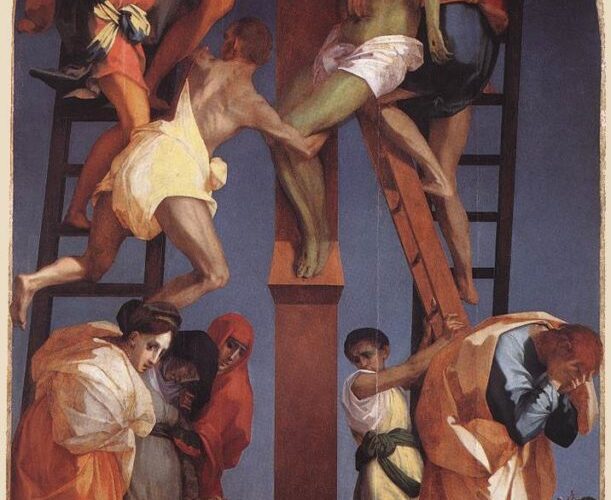
After the Renaissance revolution Florence is the protagonist of the flourishing of the great Mannerist art.
by Fabio Massimo Penna
After the Renaissance period, Florence experienced another moment of great artistic value with Mannerism. The meaning given to the term is initially negative because it underlines how, after having reached the apex with Raphael and Michelangelo, art could only face a period of decline and be reduced to an empty "manner". In reality, the new artistic conception inserted eccentric and bizarre elements into the precise representation of reality, making the license a constitutive moment of artistic doing. Central becomes the use of the "serpentine figure" that unnaturally lengthens the painted and sculpted figures, defined by their contours that recall the shape of the flame that rises in the air. Under the aegis of fashion, artistic geniuses of the first magnitude operate in Florence. Andrea Del Sarto , for example, defined by Giorgio Vasari as a painter without errors, forms in his workshop two giants of the sixteenth century Tuscany such as Pontormo and Rosso Fiorentino while in sculpture figures of absolute greatness such as Benvenuto Cellini and Giambologna stand out . Pontormo himself had work and friendship relations with another genius such as Bronzino . In short, in the sixteenth century, before the eclipse that occurred in the Baroque period, the lily city continues to be the artistic center of Italy.
An attentive scholar of Leonardo, Michelangelo and Raphael, Andrea Del Sarto would have had an even brighter career if, as Vasari always states, "a certain shyness of soul" had not blocked him in the decisive moments. When Francis I calls the artist's character to France, he is unable to enter the court and wastes the great opportunity. The remaining works, however, unequivocally testify to its greatness, starting with the famous Madonna delle Arpie of the Uffizi which, behind an apparent harmony and formal perfection, refers to the unstable poses due to the restlessness of the times. The symbolic meaning of the strange beings in the base on which the Virgin rests (the "harpies") has been much debated even if it seems that they refer to the end of the world prophesied in the Apocalypse of John. Unforgettable also the figures immersed in a sort of shaded Leonardesque of the Madonna and Child, St. Elizabeth and St. John of the Palatine Gallery. Jacopo Pontormo and Rosso Fiorentino come out of his workshop.
Pontormo's restless and solitary personality to the point that, according to Vasari, it seems he had equipped his studio on the second floor of the house with a retractable wooden staircase so as to be able to isolate himself and avoid unwanted visits. His works, then, are as far as one can imagine from a harmonious and balanced art. The anxieties of the first part of the sixteenth century appear evident in his Deposition for the Capponi Chapel in the church of Santa Felicita, in which the crowding of the figures completely covers the landscape in the background, making the setting uncertain, ambiguous. Furthermore, the two figures in the foreground that support the body of Christ seem to defy the laws of gravity, being depicted resting on tiptoes despite the weight they have to carry. Finally, the light and shaded colors contribute to the unreal atmosphere of the work. There are also few environmental notations of the Visitation of the Pieve di San Michele in Carmignano (Florence) with the four female figures in the foreground occupying almost the entire space of the table. The tormented personality of Rosso Fiorentino, on the other hand, is essentially expressed far from the lily city, leaving his absolute masterpiece in Volterra with the Deposition also without landscape with a dense framework of vertical lines formed by the cross and the three stairs leaning against it and signed by a cobalt blue bruise. The artist moved a lot and we know that from 1530 he was in France where he spent the last years of his life.
The visitor who is in Piazza della Signoria cannot fail to be struck by two sculptures located in the Loggia dei Lanzi, the bronze Perseus by Benvenuto Cellini and the Rape of Sabina by Giambologna. The statue of Giambologna, in the movement of the three twisted characters, exhibits a clear example of a serpentine figure. The same can be said of his Mercury , with a light figure that slides into space with a curving line, preserved in the National Museum of the Bargello. The Perseus , on the other hand, shows the incredible precision and attention to detail of Benvenuto Cellini who, due to his activity as a goldsmith, was at ease in working bronze. Cellini has the distinction of having been one of the first Italian personalities of the past to leave us an autobiography, which soon became a model for all subsequent autobiographers. In his Life , the author narrates, with apocalyptic tones, the lost wax casting of Perseus in a famous piece that has remained a classic in the history of sculpture. The refined statue set on the chiasmus (left arm and right leg carrying, right arm and left leg at rest) with the hero proudly exhibiting the severed head of Medusa is unforgettable for the extraordinary elegance of the forms and the accurate definition of the ornamental details. Other works confirm Cellini's incredible ability to define even the smallest details such as the incredible Saliera di Francesco I of the Kunsthistorisches Museum in Vienna, a very small work (31.2 X 33.5 cm) in which he realizes two perfect statuettes of the Sea and the Earth. In Florence by Benvenuto Cellini you can also admire the Bust of Cosimo I at the Bargello National Museum.